Archive for the ‘Crônicas/Chronicles’ Category
Um encontro incidental no feriado
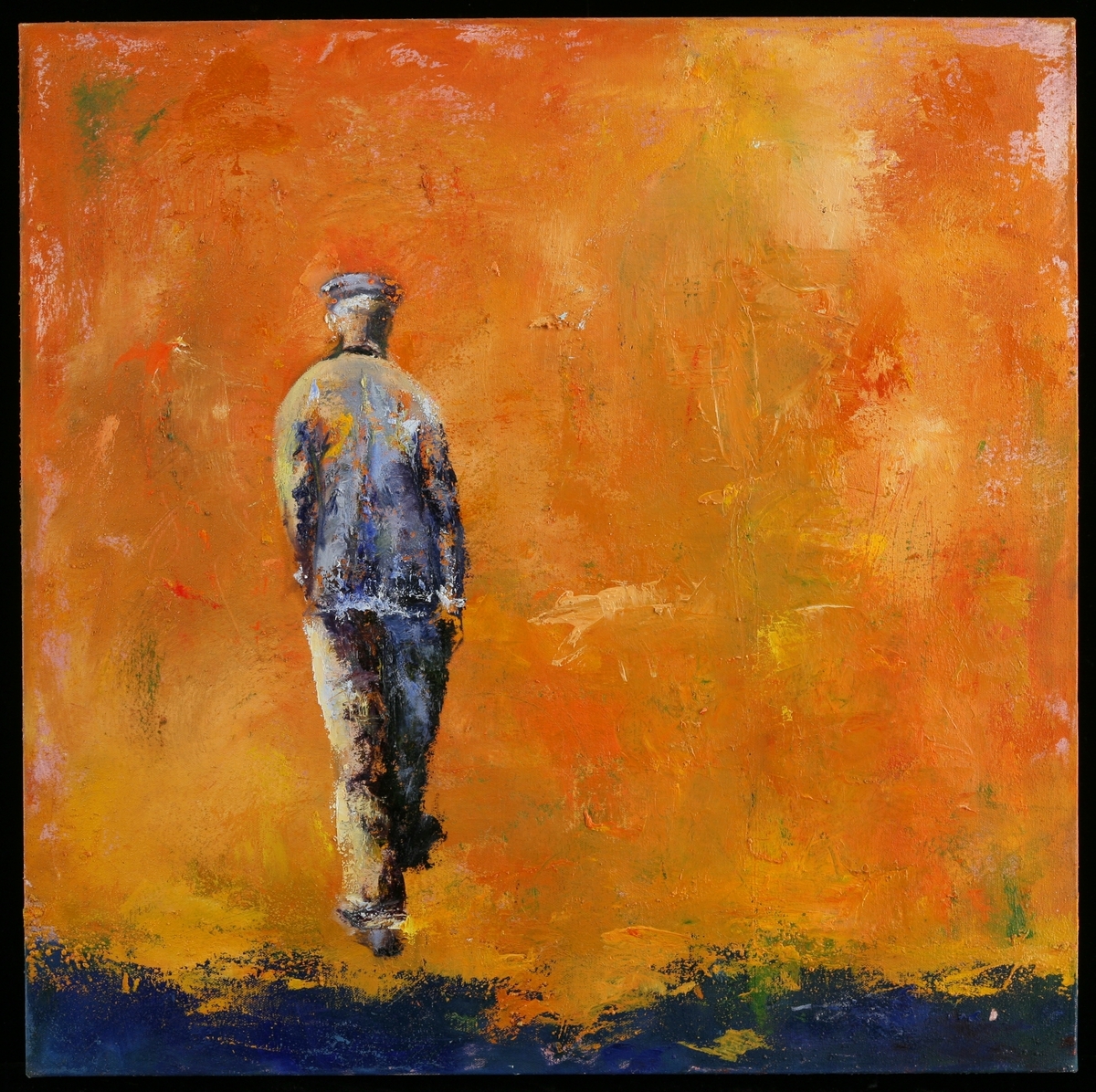
The Walking Man, de Shanna Bruschi
No feriado, aproveitando o silêncio das ruas, saí para caminhar em jejum. Uma mulher veio em minha direção e me parou na rua. Pensei que queria alguma informação.
Então ela perguntou: “Você é o David Arioch?” Receoso, acenei positivamente com a cabeça, mas não falei nada. Então ela disse:
— Nossa, cara! Seus textos são loucos! No bom sentido, claro! Você tem uns pensamentos bem intensos. Pensei que você não fosse uma pessoa, que fosse um coletivo tipo Banksy, só que com palavras, saca? Porque nunca te vi em lugar nenhum. A gente mora na mesma cidade e realmente nunca tinha te visto. Só ouço falar.
Mesmo acanhado, comecei a rir e comentei com a minha parcimônia característica diante de abordagens inesperadas:
— É que eu vivo nas sombras.
Contribuição
Este é um blog independente, caso queira contribuir com o meu trabalho, você pode fazer uma doação clicando no botão doar:
“Mas o boi tem que morrer? Ele não chora? E a família dele?”

Arte de Thomas Sidney Copper – Art Gallery Collection
No mercado, perto da fila do açougue, ouvi uma garotinha conversando com a mãe. Com a naturalidade típica das crianças, perguntou por que ela tinha que comer carne.
— Porque você precisa de proteína pra crescer forte e saudável.
— Mas o boi tem que morrer? Ele não chora? E a família dele?
Constrangida, a mulher saiu da fila do açougue com a filha enquanto algumas pessoas riam e outras refletiam.
A consciência de José
“Lendo os ingredientes para ver se não encontra nada de origem animal, não é mesmo?”

Arte: Shawn Sheperd
No mercado, enquanto eu olhava os produtos na seção de cereais, um camarada, a quem vou chamar de José, passou por mim, me cumprimentou e disse: “Checando se não encontra nada de origem animal entre os ingredientes, não é mesmo?” Balancei a cabeça em concordância e sorri.
Ele continuou: “Cara, aqueles seus textos sobre veganismo mexem com a cabeça da gente. Tenho que reconhecer.” Gostei de saber disso e comentei que a ideia é justamente essa. José deu um sorriso amarelecido e partiu empurrando seu carrinho de rodinhas tortas que dificultavam uma movimentação mais rápida.
Depois de 10 a 15 minutos, na seção de farináceos, o vi na fila do açougue. Provavelmente ele estava aguardando a vez desde que trocamos algumas palavras. Assim que me viu, desviou os olhos. Empunhando uma longa faca recém-usada para fatiar parte de algum animal, o açougueiro ajeitou o boné branco com uma mão enluvada e perguntou o que ele desejava. Mesmo à distância, ouvi sua resposta: “Não desejo nada, meu senhor, nada! Muito obrigado! Tenha um bom dia!”, e se afastou, esfregando a mão sobre o topo da cabeça e empurrando o carrinho em sentido oposto.
Continuando as compras, na seção de hortifruti, fiquei feliz por encontrar brócolis e couve-flor orgânicos a preços acessíveis. Peguei dois de cada, coloquei no carrinho e olhei à minha direita. José, como se carregasse bebês nos braços, deitou duas bandejas de iogurte grego e uma garrafa de bebida láctea dentro do carrinho quando notou minha presença.
Ele corou e tirou todos os laticínios do carrinho, recolocando-os no expositor. Testemunhando a cena, uma idosa baixinha segurando uma caixinha de leite de arroz com as duas mãos falou: “Você fez bem, filho! Leite de bicho faz mal. Olhe como você está vermelho!” Só ouvi um não sonoro e desajeitado que afastou a boa senhora, mas não sem antes fazê-la agigantar os olhos e levar as duas mãos ao coração, sem entender o que aconteceu.
Quando me recordei que em casa não havia mais alho, me apressei até a banca e, coincidência ou não, vi José segurando duas bandejas de ovos de galinha. Ele parecia preocupado em ser visto por alguém, e movia a cabeça de um lado para o outro. Não notou que havia uma plaquinha amarela avisando que o piso estava escorregadio. Gritei seu nome em vão. José não ouviu e foi ao chão, caindo sentado e resfriando o traseiro. Não restou um ovo inteiro.
A raiva era tanta que ele grunhiu: “Nunca mais como ovo na minha vida! Nunca mais! Para os diabos com os ovos!” Sorte ou não, nenhum o atingiu. Me aproximei para ajudá-lo a levantar, só que ele recusou: “Estou bem, David. Me deixe, estou bem!” As pessoas o observavam sem entender o que se passava com José. Preocupado com as horas, caminhei até as seções de produtos de limpeza e higiene, o que me tomou um tempinho considerável.
Já no caixa, logo à minha frente, encontrei José esvaziando o carrinho e colocando as compras sobre o balcão. No fundo, restavam três bandejas de embutidos, um saquinho com carne moída e outro saquinho com bifes. Ele os posicionou sobre o balcão, mas quando me viu logo atrás, levou um susto e sorriu. Retribuí o sorriso e José chamou a atenção da moça do caixa: “Olhe, alguém deve ter colocado por engano esses embutidos e essas carnes no meu carrinho. Isso aqui não é meu. Vou deixar aqui do lado.”
O rato e a criança

O rato e o chocolate
Vi um rato indo em direção à boca-de-lobo com um pedaço de chocolate. Uma garotinha se aproximou e gargalhou sem maldade. O roedor se esquivou e a criança chorou. Ninguém se entendia, parecia. Anormal e natural, dizia a lágrima que descia. Enquanto um se desprendia, o outro, coagido pela dureza vida, não se rendia.
O gato
 Voltando da academia, um gato saltou no capô do meu carro. Quando uma moça se aproximou para pegá-lo, ele pulou em meu colo e começou a miar e a esfregar as unhas na minha barba, como se procurasse alguma coisa.
Depois de tanta insistência, e já me sentindo sem jeito diante da situação, da minha barba caiu um pedaço de pão. O gato comeu, miou, saltou e bebeu a água que a moça serviu em um potinho na calçada.
Satisfeito, deu uma última olhadela para mim e para a moça antes de correr para a escuridão, onde vi seus olhos denunciarem intenção. Estava feito! Um pneu furado e riscos na lataria.
O gato cobrou de quem o destratou. Deixou sua assinatura em uma caminhonete estacionada sob a luz bruxuleante de um poste, onde seus riscos cintilavam como faíscas de azar e sorte.
Um motorista embriagado

Desci e caminhei em sua direção. Embriagado, o sujeito mal falava (Arte: Reprodução)
Em novembro de 2014, eu estava em frente a um mercado quando um motorista bateu à esquerda do meu carro e seguiu ziguezagueando pela rua. Quando vi o amassado pelo retrovisor, fui atrás dele. Sinalizei para que parasse e ele encostou o seu Corcel II bem deteriorado, com o escapamento arrastando no asfalto.
Desci e caminhei em sua direção. Embriagado, o sujeito mal falava. Sua esposa também desceu e expliquei que ele bateu no meu carro. Constrangida, a mulher se desculpou enquanto o marido fazia caretas, ria e tamborilava as mãos sobre o capô do carro. Ele parecia não se importar com a situação. No banco de trás, uma garotinha de tranças, com três ou quatro anos, assistia tudo em silêncio, segurando uma bonequinha inteiriça de plástico duro, dessas mais baratas.
A esposa do motorista me deu o número do seu telefone e implorou para não chamar a Polícia Militar. Na realidade, eu nem tinha essa intenção. Ela sugeriu que eu entrasse em contato para passar o orçamento do conserto. Antes de ir embora, perguntei de onde eles eram e o que faziam. “A gente mora e trabalha na roça dum homi aí, ‘samo lavrador’. Tamu ino visita o túmulo da minha mãe. Pedi pra ele não beber, mas é teimoso demais. Cê pode ligar qualquer hora”, se justificou constrangida.
Nunca liguei. Só assisti o sujeito serpenteando o carro e desaparecendo dois quarteirões abaixo enquanto a fumaça do escapamento ocultava o veículo. A sinuosidade de suas vidas talvez fosse representada pelos traços sulcados no rosto daquela mulher precocemente envelhecida. Meu prejuízo material nem de longe se aproximava do seu padecimento existencial.
Contribuição
Este é um blog independente, caso queira contribuir com o meu trabalho, você pode fazer uma doação clicando no botão doar:
Minha mãe conta…
Minha mãe conta que quando eu era criança, não sei exatamente a série, a professora de matemática me perguntou se um dia eu não gostaria de ganhar muito, mas muito dinheiro. Hesitei por um instante, na minha inocência característica, e respondi:
— Não, num quero!
— Mas por que não, David?
— Porque vou ter que parar de brincar só pra juntar papel.
Sete pãezinhos e um fujão

Peço sete pães e aguardo a atendente selecioná-los na sua rotineira cordialidade (Foto: Reprodução)
Na padaria do mercado, peço sete pães e aguardo a atendente selecioná-los na sua rotineira cordialidade. De repente, escuto um som fofo e morredouro na sua sutilidade – do tipo “ploft” suave. O pãozinho agoniza no chão. Gerado há pouco tempo, já não tem mais razão de ser, caído sem chance de se restabelecer. Posso ver nos olhos da atendente que ela discorda. Me observa de soslaio, esperando apenas uma distração e, quem sabe, numa plena desatenção, uma oportunidade de enfiar no saco o “pãozinho sujo”, privado da própria vocação.
Não tiro os olhos dela. Ela reage virando as costas para mim, e manipula o saco de pão com uma astúcia que parece sem fim. Não desiste! E meus olhos continuam mirando-a. Escuta meus passos. Sei disso porque vejo suas orelhas vibrando e seus olhos titubeando. Estamos mais próximos do que antes. E minha sombra desarmoniza suas intenções. Ela disfarça por mais um ou outro segundo, sorri em minha direção, e encosta o pãozinho na parte externa do saco marrom.
Há um ou dois minutos, ele era igual aos outros. Ninguém pode negar, mas foi maculado, e aos seus irmãos já não pode se juntar. Que assim seja feita a justiça do alimento! Juro que por um segundo vi um traço que parecia um sorriso. Um pão sorrindo? Impossível! Ou não? A moça da padaria me entrega o saco de pão quente. Ruborizada, me dá um último sorriso, sem velar o ar de derrota.
Quando abro o saco, e, descuidado, inalo a fumaça que me esbraseia o salão, vejo sete irmãozinhos parifomes repousando. Do outro lado, o pãozinho fujão se esconde de baixo de um segundo balcão, e desaparece em um buraco do tamanho de minha mão.
Contribuição
Este é um blog independente, caso queira contribuir com o meu trabalho, você pode fazer uma doação clicando no botão doar:
No caixa do Muffato
Na fila do caixa do Muffato, encontrei uma mulher sofrendo para carregar a compra em uma cestinha, então me ofereci para ajudar. Quando chegou a vez dela, a filhinha, que deve ter uns três anos e carregava um pacote de bolachas e um saquinho de frutas, esperou eu me afastar um pouquinho e disse: “Que muçulmano bonzinho, mãe!”
Children of the White Gold Cinema
I saw the tears streaming down his face, wetting his plaid shirt buttoned up at the point of his neck

The White Gold Cinema, one of the great entertainment points of the population of Paranavaí (Archive: Osvaldo Del Grossi)
I am not part of a generation that has the strongest and clearest memories of the White Gold Cinema, one of the great entertainment points of the population of Paranavaí, in the Northwest of Paraná, until 1993. When the cinema was closed, I was still a child. Despite this, I went to the Gold Cinema for a few years of my childhood, and I have fond memories of that time.
My first time at the movies was a session of “The Bumbling Heroes – An Adventure in the Jungle”, on a weekend in 1988. By then, the biggest screen I had seen was the 21-inch TV, covered by a box of varnished wood, which was in the living room. Even so, I was happy watching cartoons on it.
As soon as my brother, my mother and I arrived in front of the White Gold Cinema, in Manoel Ribas Street, in the downtown, I paid attention to the people lined around the box office. Tiny, I watched everything in the proportionality of my stature. I saw more shoes, legs and belts than faces. Except, of course, when people were as little as I was.
Before we got inside the cinema, I walked slowly and backwards along the sidewalk, trying to observe the height of the White Gold’s building, but it was impossible for me. So, I thought that was the biggest movie theater in the world. Who knows, maybe it crossed the skies and had direct contact with the paradise they talked about in school.
The gentle popcorn seller smiled at me, noticing through my large, cylindrical black eyes that it was my movie debut. “Is it your fist time?” You’ll like it and you’ll want to come back many times”, he said, straightening a small amount of sweet pop corn, preventing it from mixing with the salty one.
Warm and smelling, the popcorn popped into the cart. For a moment, I believed, in my boyish illusion, that maybe the popcorn had a life, and wants to go to the movies to watch “The Bumbling Heroes”. By my side, prevailed a sweet aroma that pacified the most bewildering children – yes, it was an effective white-hot soothing odor.
It reminded me of the airy red tabebuia tree, that I saw every day near my house, when I pointed with my finger and shouted: “Look that sweet popcorn tree!” On the other side of the popcorn cart, the smell of popcorn changed, as well as the public. The adults, especially the men, approached and asked: “Give me the salty one, please!”
Skilled, the popcorn seller knew the exact amount of popcorn to fill every bag. I watched his grooved hands glittering in front of the small yellow lamp that glowed and gilded his wrinkled face. It was that way, whenever he leaned in or steeled himself. That was his spectacle, and at the entrance of the White Gold Cinema, nobody was more important than the popcorn seller.
On that day, before we went to the cinema, five shoeshine boys, aged between 6 and 14, approached. They leaned against a wall next to the White Gold Cinema and, as the ragamuffins boys from Buñuel’s “The Young and the Damned”, started smoking, watching families getting out of cars and crossing the sidewalk.
“If I had a father or a mother I would not be in this life, brother! Being poor and alone is not easy. No, sir! Look how much luxury those kids have”, said one of the four boys to his friends. Without a word, they just shook their heads in agreement, crushing little butts with their little feet.
Dirty, with grimy nails and the nauseating smell of cheap cigarettes, a shoeshine boy no more than 12 years old lead a group of kids. As someone hesitant about entering or leaving, he folded his arms and raised his face as one of the entrance lights highlighted his dubious expression of satisfaction
“Guys, listen up! Quickly! This movie ‘Bumbling Heroes’ is very good. There’s only one bad thing. Mussum and Zechariah die at the end. Thanks! Bye! “He shouted and ran laughing, while his dark and curly hair was fluttering. At that moment, he became an antagonist worthy of the villain Scar.
The boy dragged his shabby slippers and, with his companions, went down to Pará Street. Some children did not care about the revelation, but others were so angry that they wanted their parents to call the police or do something about it. For good, no one pursued them.
Inside the Gold White, I was stunned by the out of sight seats. “There are one thousand five hundred seats here. Look up there, it’s like an opera”, my mother told us, watching our reactions. Unhurried, we spun around the mastodontic room, trying to see all the details.
Luckily, there were vacant seats in the front row. Then, we walked there, crossing hallways and listening to the sounds of spectators eating popcorn, talking, making fun of someone and hugging each other. Near us, the usher accompanied everything with its indefectible aura of firefly. He felt like the leader of a coliseum where nothing would happen without his permission, especially when the lights went out.
As soon as I sat down, I observed a boy in mended clothes sitting next to me, accompanied by his mother. His name was Juscelino, and he was a year or two older than me. It was also his first time at the movies. I noticed his anxiety because his small feet kept swinging, as did mine.
His trembling hands sweated so much that every time he wiped them on the sides of his plaid pants. Juscelino was talking to me, keeping his face toward the disproportionate projection screen. I thought he was excited because of the movie, until I noticed something different in his eyes, a crystal clarity like I’ve never seen before. Naturally, the mother revealed that her son was born blind.
Juscelino could not see anything. Still, his excitement at White Gold Cinema surpassed even mine. The sounds and smells that came to him were like immaterial gifts, memorials. With a rare auditory and olfactory acuity, Juscelino could even see what people were doing or eating in the furthest seats- and he liked to discuss everything with me.
Son of peasants from Alto Paraná, he arrived in Paranavaí by bus in the morning, and stayed waiting for hours for the ticket office to open. His father could not participate in the big event, because the savings just barely covered the expenses of his wife and child. “It’s going to start, mom!” Said the little boy seconds before the projector started showing the movie, as if he had a gift for omens.
From beginning to end, Juscelino was completely silent, trying to absorb as much sound information as possible. Occasionally, he moved about the chair without making a sound, worried about bothering people. Juscelino, my brother and I were united by an experience that would never be repeated. Our greatest discoveries were visual, and those of Juscelino were auditory. Perhaps even richer than ours, as he put himself in the position of creator by putting forth to the creativity of everything he heard.
Still in the dark, I saw the tears streaming down his face, wetting his plaid shirt buttoned up at the point of his neck. At the end, with the return of the lights, I asked him what it was like to watch a movie at the cinema without being able to see. My mother scolded me, but Juscelino’s mother did not mind the question.
“I can not explain it right, but I see, yes, I just do not see with my eyes. I see everything I carry inside me”, he justified before taking hold of his mother’s hand and walking in short steps toward the exit. The artificial lighting contrasted and harmonized with the compliant light of the newly arrived portentous moon.
On the corner, at the intersection between Pará and Manoel Ribas Street, the five shoeshine boys, children living as adults, drummed their boxes. They were seated on the curb, immersed in false smiles and sullen stares, trying to exist for a world that scarcely recognized their true intentions.
Returning home on foot, we crossed the street. As we passed them, the same boy, who caused the commotion at the entrance to the cinema, pulled me by the arm and, with an implied look, asked “Hey, my friend. Can you tell us the story of the movie you saw there at the cinema?”
Support
This is an independent blog, if you want to support my work, you can make a donation by click on the donate (doar com) button: